
At the end of September 2026 Serenity Scotland and Welcome to Fife were hosted by Newburgh Handloom Weavers. Situated on the south bank of the Firth of Tay in North-East Fife, Newburgh Handloom Weavers stands as a living testament to Scotland’s rich textile heritage. Established in 2017 by highly experienced weaver Jimmy Hutchison— bringing more than half a century of weaving experience and roots in the Outer Hebrides—and designer Erika Douglas, the weaving shed revitalises a craft that once defined the industrial and social landscape of the region. Apparently Jimmy sings while weaving. Unfortunately on this occasion we did not witness such a special treat!
A Newburgh Dawn
A visit of experiential learning, and creative tourism, Newburgh Handloom Weavers acts as a vital cultural anchor; rather than treating history as a static museum display, it actively keeps centuries-old trade knowledge alive through bespoke creation, public demonstrations, and hands-on teaching. In doing so, it helps to preserve Fife’s storied weaving narrative as a dynamic, tangible part of Scotland’s contemporary identity.
Fife’s history is inextricably linked to textile manufacturing. In the 18th and 19th centuries, handloom weavers in towns across the Kingdom – such as Newburgh and Dunfermline – were heavily involved in handloom linen production, driving the local economy and forging a distinct artisan identity. As textile production shifted from domestic handlooms to mechanised factories, traditional handloom weaving declined. Mechanisation displaced many domestic weavers and contributed to economic hardship and migration; one example was the Carnegie family (of Andrew Carnegie fame), who moved in 1848 from Dunfermline to Allegheny City, Pennsylvania.
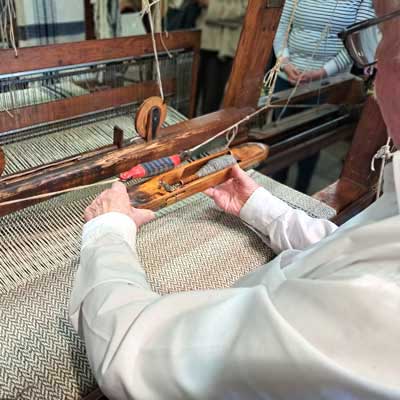
Newburgh Handloom Weavers bridges this historical gap by operating non-mechanised Thomas Kennedy wooden looms originating from the late 19th century. Driven purely by manual skill—shuttles thrown by hand and treadles worked by foot—the workshop preserves the tactile art, rhythm, and precision of historic Scottish weaving.
Culturally, the business embodies a modern ethos of sustainability and heritage conservation. Using 100% pure new wool, much of it sourced from Scottish suppliers, and collaborating on hyper-local initiatives including the Falkland Blanket, a limited-edition, heritage, single-origin product made from wool from organically reared sheep on the Falkland Estate—the studio roots its craft directly in Fife’s agricultural landscape.